
India does not have one ecommerce market. It has two.
And only one of them is going to create the next $100B winner.
Let’s break down the real story using the numbers hiding in plain sight.
1. Meesho Isn’t Competing in the 10-Minute Economy
It’s competing in the 300-million-household economy.
Most of India’s ecommerce thinking has been shaped by a tiny, highly urban cohort.
But Meesho’s real unlock came from designing for a user base the incumbents structurally couldn’t serve:
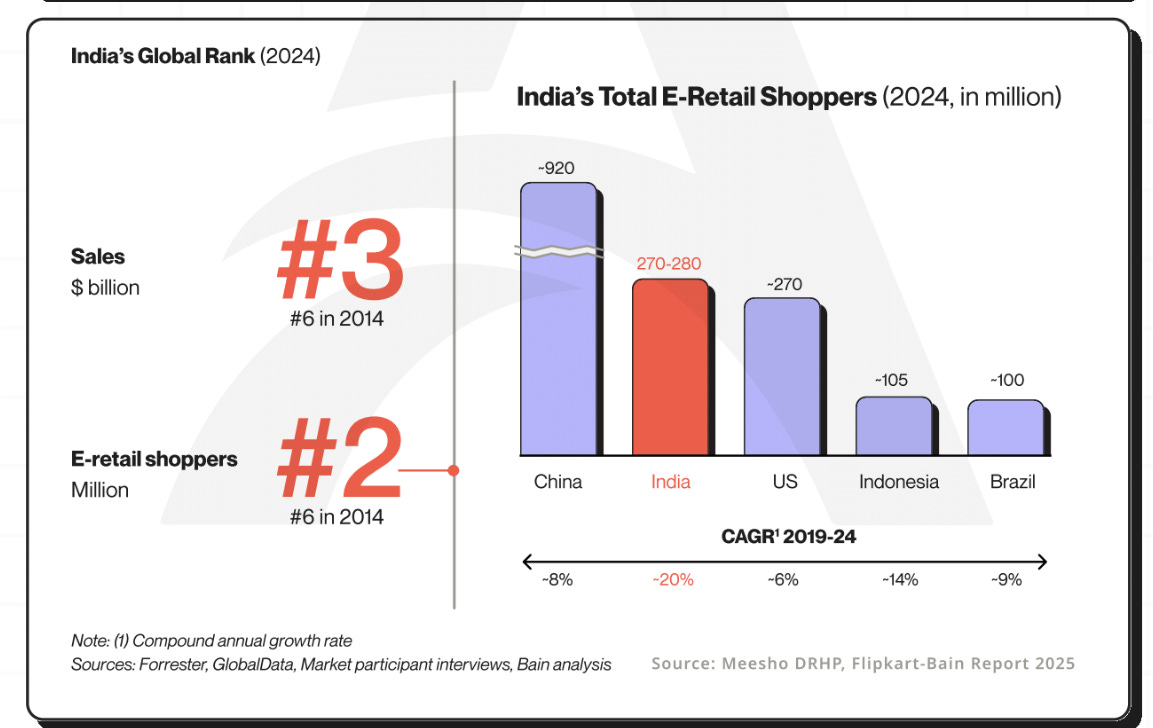
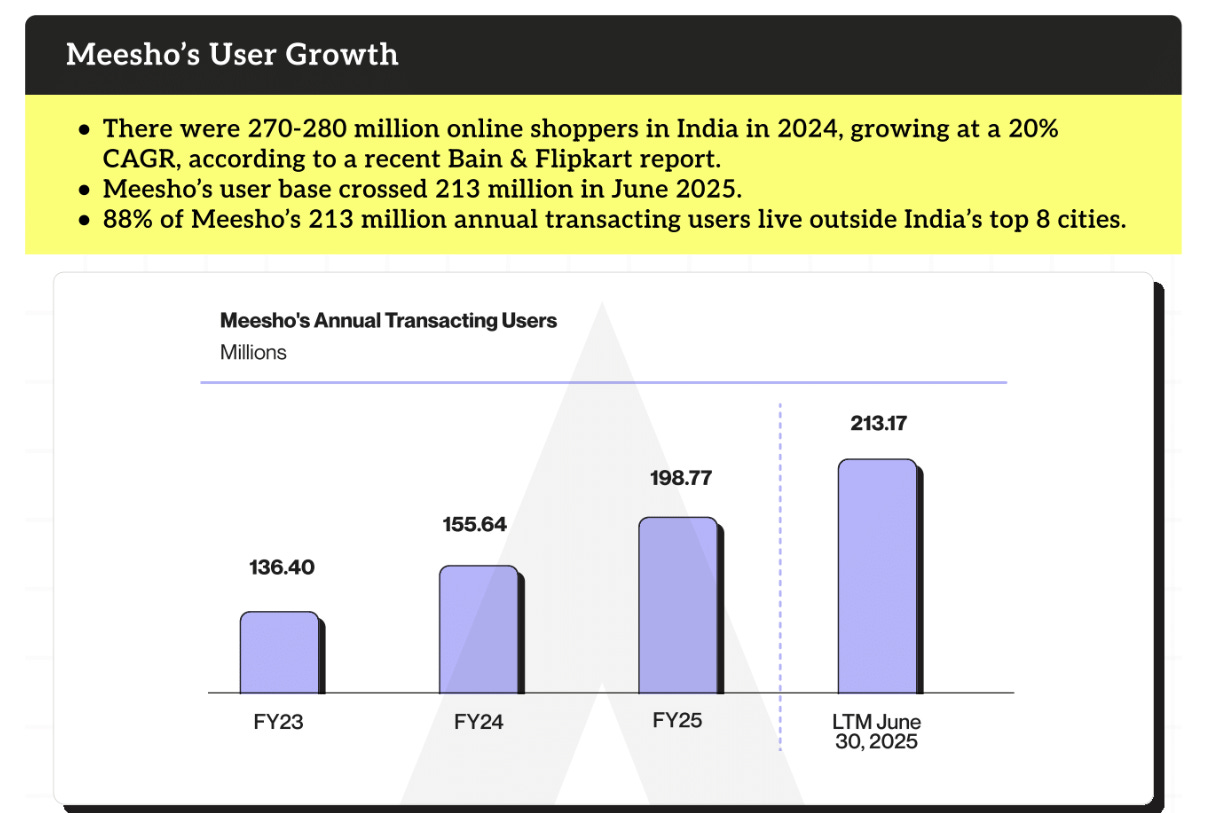
213 million annual transacting users
88% outside top 8 cities
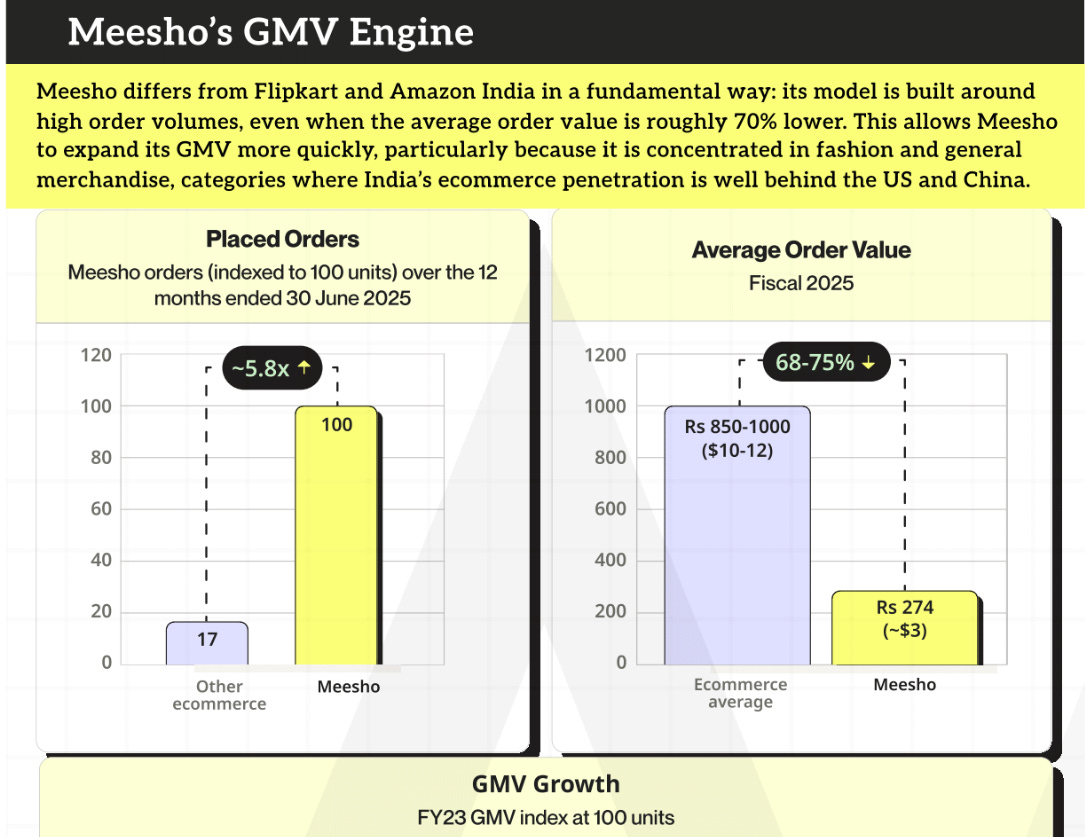
AOV of ₹274
~6x more orders per capita versus other ecommerce players
No platform in India’s history has ever built for this segment with this depth.
And here’s what this user teaches us:
They don’t need 10-minute delivery.
They need 10-rupee affordability and 10-click trust.
Speed is a premium feature.
Affordability is a mass-market unlock.
2. India Is Moving From “Big Basket” Ecommerce to “Many Small Baskets” Ecommerce
Everything Meesho does is built around one truth almost everyone underestimated:
India’s ecommerce is shifting from large, infrequent purchases to small, frequent ones.
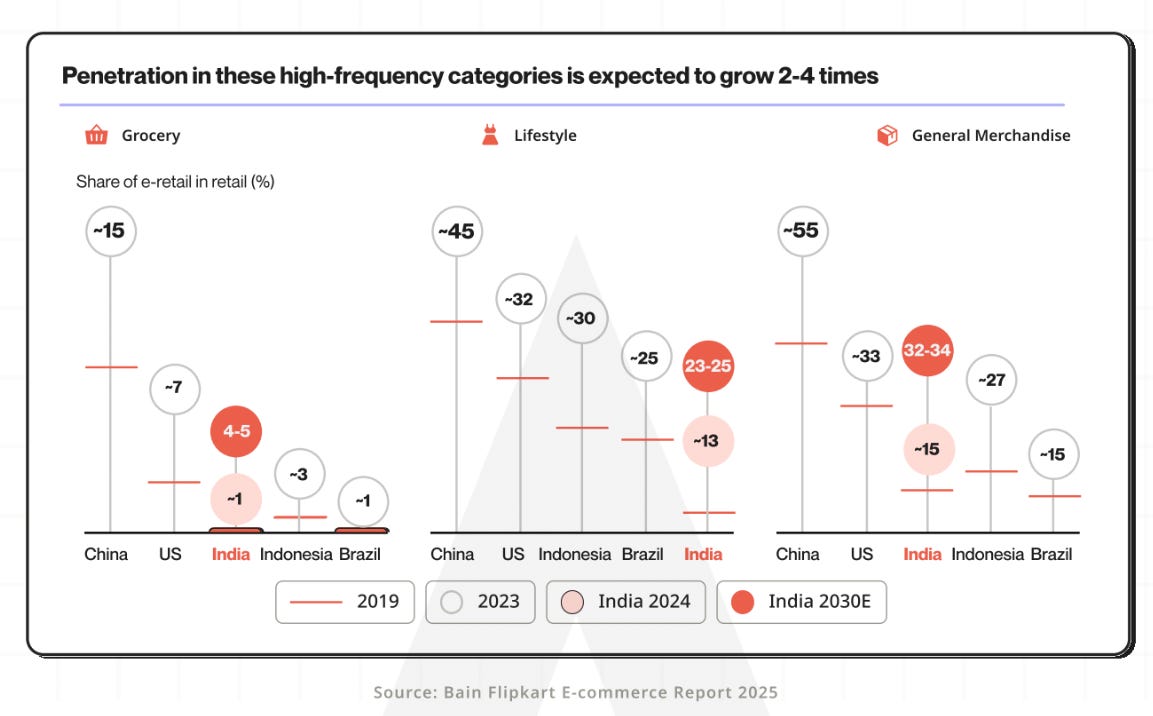
Between 2020 and 2024, the combined share of grocery, general merchandise and fashion jumped from 35–37% to 55%.
By 2030, Bain projects this hitting 65–70%.
This shift has massive implications:
• The AOV of mass-India ecommerce will keep dropping
• Orders per user will keep rising
• The market will favour discovery over intent
• Price friction will matter more than delivery times
• Basket behaviour will look more like Shopee than Amazon
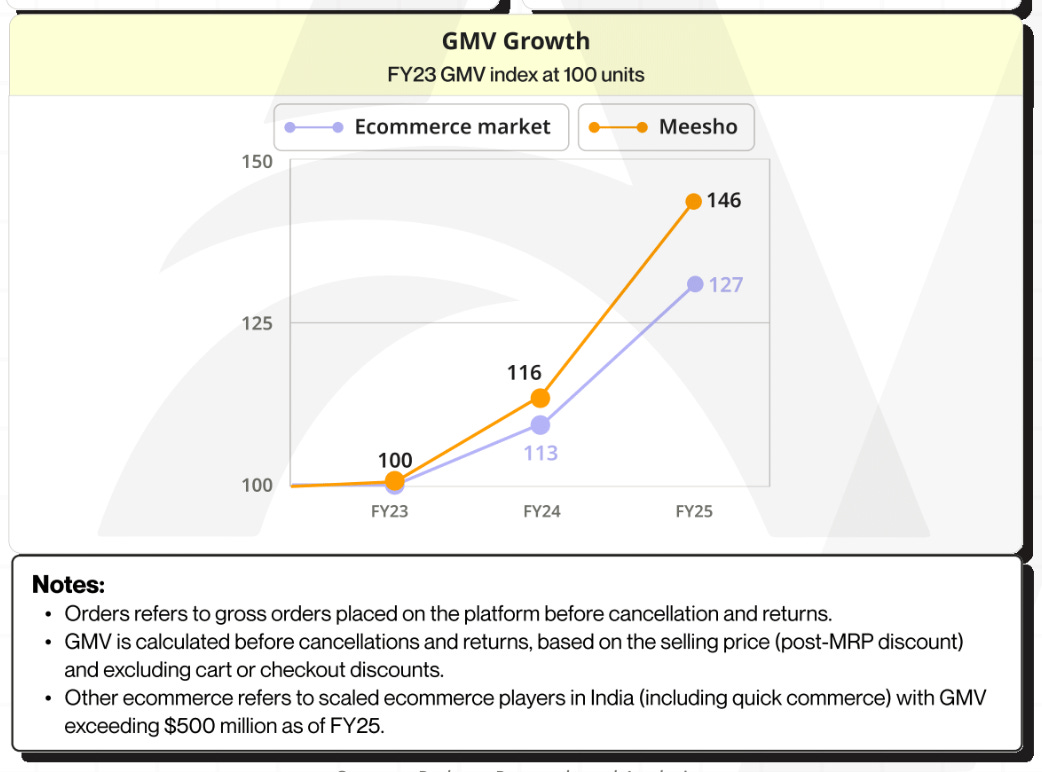
This is precisely why Meesho’s GMV engine is so explosive.
While the average ecommerce platform sees 17 indexed orders, Meesho sits at 100.
Its average order value is 70% lower, but its frequency is 5–6x higher.
This is not a bug.
This is the model.
3. Why 10-Minute Delivery Makes No Sense for Meesho
(And why the question keeps coming up anyway)
Let me be blunt:
10-minute delivery is a capex-heavy, density-dependent, premium-user feature.
Meesho optimises for the opposite:
• Lowest cost per order
• Highest order density
• Asset-light logistics
• Fragmented, hyperlocal delivery partners
• A universe of small-ticket, high-frequency SKUs
Valmo (Meesho’s logistics rails) already moves 1.2B shipments, comparable to Delhivery, but with zero warehouse ownership.
Why would a platform built on “₹50 margin per order at scale” suddenly chase a model built on “burn ₹50 per order for speed”?
It won’t.
Because Meesho isn’t trying to win the Swiggy Instamart customer.
It’s trying to win the Bharat customer who buys 15–30 times a year but won’t pay ₹15 extra for speed.
And that segment is 10x larger.
4. The Real Next Bet: Fintech, Not 10-Minute Grocery
Ecommerce platforms globally have found the same answer to the same question:
“Where does margin come from at scale?”
Not from delivery.
Not from commissions.
From financial services.
Shopee: One-third of EBITDA from fintech
MercadoLibre: 40–50% of revenue from fintech
Amazon: Billions from lending + payments
Meesho has started walking that same road:
• Merchant loans via PayU
• BNPL experiments with 15–30 day cycles
• Transaction-level underwriting
• Embedded credit for long-tail merchants
This is where the next 10-year margin curve lies.
Not in shaving 20 minutes off a delivery timeline.
5. Grocery Will Happen But Slowly, and on Meesho’s Terms
Online grocery penetration in India is 4–5%, vs 15% in China.
By 2030, India will likely reach 10–12%.
That’s a massive opportunity.
But Meesho will not do quick commerce.
Its grocery unit is a “startup within a startup,” running on a tight budget, testing for:
• State-by-state buildouts
• Central warehousing
• Hub-and-spoke distribution
• Ruthless unit economics before scale
Their FY25 grocery pilot numbers show it clearly:
• Revenue: ₹1.67 crore
• Losses: ₹79.37 crore
• FY26 Q1: ₹0.13 crore revenue, ₹14.14 crore losses
These numbers aren’t sexy.
But they signal discipline.
Meesho isn’t in a hurry.
Grocery won’t be a blitzscale category for them—
it will be a unit-economics-first, locality-specific, long-horizon build.
6. What Everyone Keeps Missing
The question is not:
“Will Meesho do 10-minute delivery?”
The real question is:
“What happens when India’s 400–500 million new internet users transact like Meesho’s first 200 million?”
Because if that happens, three things follow:
Order frequency will double or triple
High-frequency categories will dominate ecommerce
GMV will bend upward in a way India has never seen before
Meesho is not building for speed.
It’s building for scale.
And in a country where the next 300 million shoppers won’t behave like the first 30 million, scale beats speed every single time.
The Verdict
After leading growth at Swiggy/Zomato and building category engines at Flipkart, here’s my view:
Meesho will not take the 10-minute delivery route
because the future of Indian ecommerce does not belong to 10-minute users.
It belongs to the 10-crore households who shop 20–40 times a year,
care about every ₹10 saved,
and are just getting started.
And Meesho is the only company built for them from Day 1.