
There are waves that sneak up on you and waves that announce themselves long before they arrive. India’s GLP-1 moment belongs to the second category. You can already feel the pull of the tide.
For years, these drugs lived in the quiet corridors of endocrinology clinics. They were expensive, rare and vaguely associated with “diabetes management.” Suddenly the global conversation flipped. GLP-1 therapies became cultural objects, economic forces, even political talking points. And while the hype looped around Hollywood and Wall Street, something much more interesting began brewing in India.
When markets move, they usually move around emotions, narratives or macro shocks. This one will move because of a line of text in a patent office.
The TAM Is Practically the Country
If you want to understand why this matters, start with the sheer scale of India’s metabolic burden. More than 100 million people are living with diabetes, another 100 million are on the brink, and well over 200 million are somewhere on the obesity spectrum. This is not a segment. It is the broad base of India’s economic pyramid. It touches every household, every office cafeteria, every wedding buffet.
For decades the response to this crisis relied on education and willpower. Neither scaled. GLP-1s finally offer a biological unlock. They reduce weight at levels once thought possible only through surgery. They improve cardiovascular outcomes. They dramatically ease the burden for people whose bodies have been fighting them for years.
The problem is price. Today, these therapies cost more per month than many Indians spend on rent. Which is why the 2026 patent expiry is so important. Once generics arrive, monthly costs drop from five figures into the low thousands. At that price, access explodes.
India has seen this pattern before. Data costs collapsed and half a billion people came online. Payments became free and digital transactions went from novelty to default. When the cost curve shifts, India shifts with it.
GLP-1 affordability is that kind of shift.
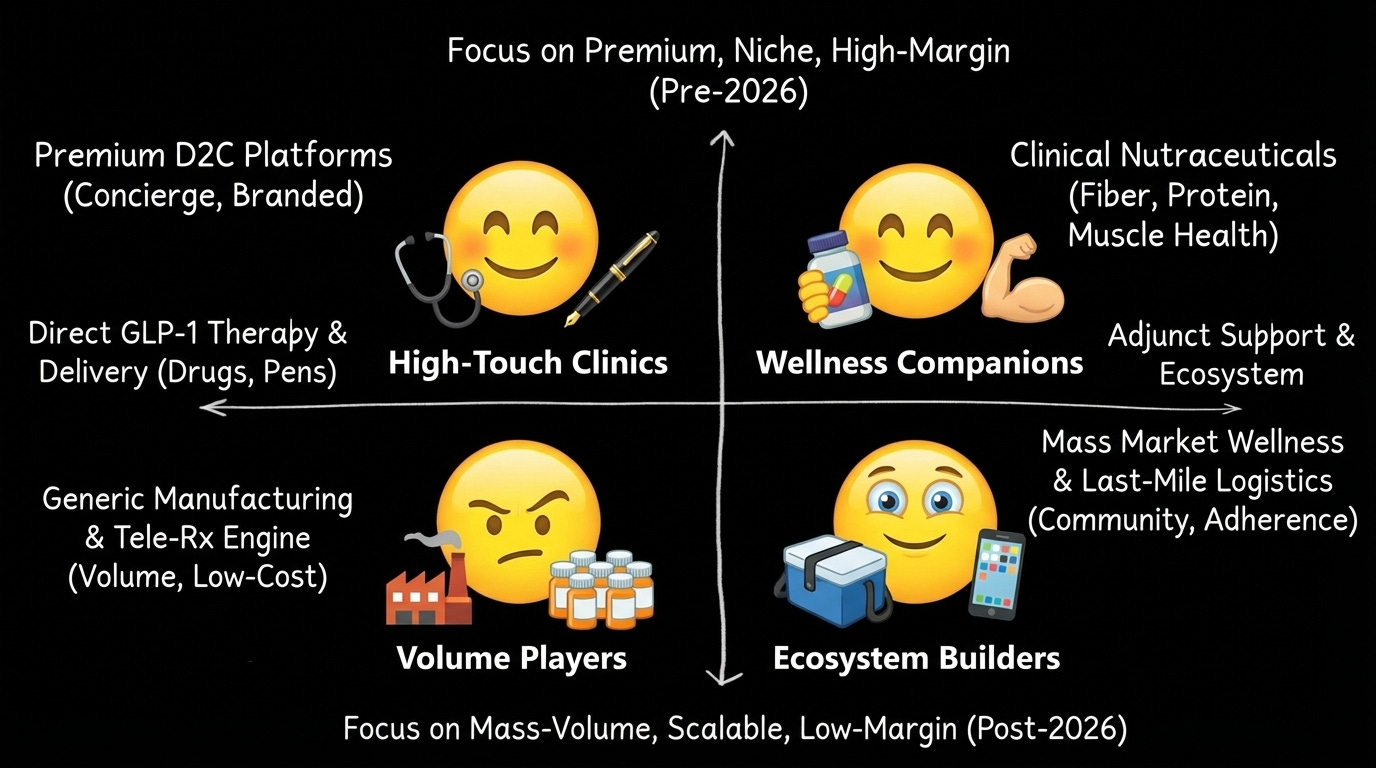
The Premium Window: A Short-Lived, High-Margin World
Right now, before the price collapse, India is living through a curious moment. A thin slice of affluent consumers has already embraced GLP-1 therapy, even at today’s astronomical costs. But they aren’t merely buying a drug. They’re buying handholding.
Doctor calls. Nutritionists on WhatsApp. Weekly check-ins. Concierge-style dose management. It is a world where metabolic health looks less like a treatment plan and more like a membership.
This window is small, but the margins are real. Startups in this arena have discovered something powerful: people don’t want to lose weight alone. They want a team, a system, a story to plug into.
The catch? This entire category exists only because the therapy is expensive. Once generics land and prices plummet, the economics shift. The moat around “premium coaching” evaporates. The moat around “trusted access and safe delivery” expands.
These companies must enjoy the premium era while it lasts but use the capital and learnings to pivot. What thrives today will not survive tomorrow in its current form. But the brands that earn trust now could become the front door of India’s metabolic revolution later.
The Tele-Rx Engine: The True Long-Term Prize
Post-2026, the real battle begins. When GLP-1s become affordable, millions of Indians will need:
medical eligibility screening
correct dosing
side-effect management
monthly adjustments
prescription renewals
long-term monitoring
This is not a wellness app challenge. This is a national workflow challenge.
Imagine a system that can conduct a consultation for a Tier-2 patient at noon, dispatch a prescription by 12:03, sync with a pharmacy by 12:05 and track adherence by evening. At scale, this needs to happen millions of times a month.
That is a tele-Rx engine.
Most of India’s current telemedicine stack was designed for general care. GLP-1s require something closer to an orchestration layer. Precision, compliance, titration schedules and high follow-up frequency.
The companies that crack this are not just building a platform. They are building the nerve center of India’s metabolic health infrastructure. And their scale advantage could be enormous.
The Nutraceutical & Protein Boom
Every major consumer shift comes with an unglamorous yet massive sidecar opportunity. For mobile internet, it was headphones and power banks. For fitness, it was whey protein. For GLP-1s, the sidecar is already revealing itself: comfort and muscle preservation.
Patients need fiber to manage digestive discomfort. Electrolytes. Gentle anti-nausea formulations. And perhaps most importantly, high-quality protein and amino acids to protect lean mass during rapid fat loss.
Millions of Indians could find themselves, for the first time in their lives, needing functional nutrition to support a medical therapy. That is not a niche. That is a category-defining moment.
In the West, this market is exploding. In India, it is waiting for brands that can combine science, trust and taste. Not influencers selling “detox gummies.” True metabolic wellness brands with clinical credibility.
This will become a multibillion-rupee category. And unlike drugs, it does not require waiting for a patent expiry.
The Manufacturing Supercycle
While the consumer conversation heats up, something equally important is happening behind the scenes. India is quietly assembling the industrial backbone of the GLP-1 world.
API capacity is expanding. Pen injector manufacturing is scaling. Fill-finish plants are being retrofitted. Global companies are scouting Indian partners. And many of the raw materials and intermediates that power GLP-1 production will be sourced from Indian factories within a few years.
If India became the generics capital of the last era, it may become the peptide capital of the next.
This is not just domestic supply. This is export potential. Margin potential. Dependence-reduction potential.
GLP-1s may become the most important drug class of the 2030s. If India positions itself correctly, it will not just be a consumer. It will be the factory floor of the world’s metabolic transformation.
The Last-Mile Layer
All revolutions run into the brick wall of real life.
India will need safe injections in cities where people are uncomfortable with needles. It will need reliable cold-chain storage in towns where temperatures hit 42°C. It will need micro-clinics and nursing support in markets underserved by specialists. It will need pharmacies equipped to handle storage and administration.
This is the unsexy, critical layer that determines whether the GLP-1 wave reaches Tier 2 and Tier 3 India or dies at the metro border.
Think of:
home-injection assistance services
micro-clinics inside pharmacies
school-of-pharmacy-level training pipelines
regional cold-chain hubs
subscription-based adherence services
The consumer revolution will take place on screens.
The clinical revolution will take place in neighborhoods.
Whoever builds this layer earns trust in a way software alone never can.
Put Together
A short-lived premium window.
A long-run mass-scale tele-Rx engine.
A huge satellite nutraceutical market.
A manufacturing supercycle.
A last-mile transformation.
It is rare for all five layers to line up at once. It is even rarer for them to line up around a single medical innovation whose price curve is about to collapse.
This is what makes India’s GLP-1 moment so compelling.
Not the drug.
The ecosystem it unlocks.